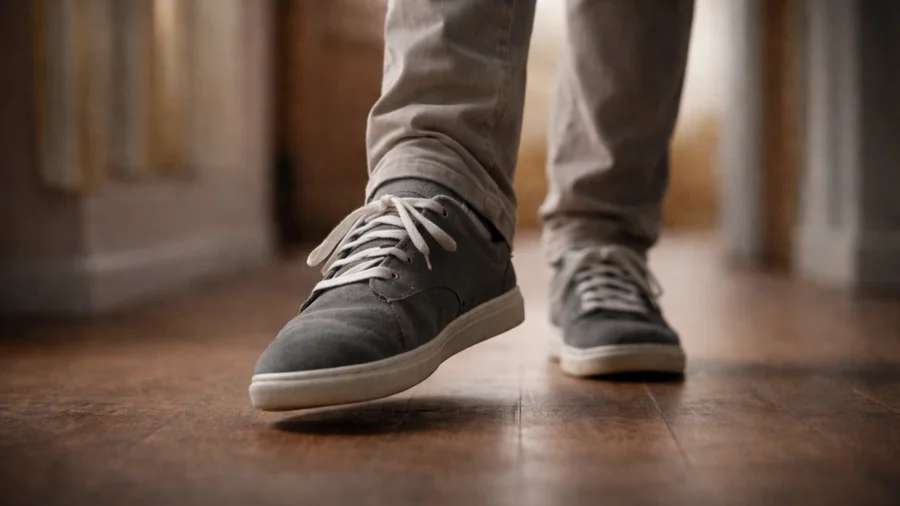
Illustration of foot drop while walking (AI-generated)
Foot Drop in CMT: When the foot no longer lifts properly while walking
When the foot can no longer be lifted properly while walking, every step becomes less secure. That is exactly what happens with what is known as foot drop.
For many people, it begins gradually. In my case, I suddenly found myself stumbling more and more often because the front of my foot kept catching. Looking back, it probably developed over a longer period of time. But in the moment, it felt more sudden.
What is foot drop?
With foot drop, lifting the foot no longer works properly. Under normal circumstances, the muscles in the lower leg make sure the foot is pulled slightly upward while walking.
When that function is limited, the front of the foot catches on the ground more easily.
That leads to more frequent stumbling or an unconscious change in the way a person walks.
Why does foot drop happen in CMT?
In Charcot-Marie-Tooth, the nerves that control the muscles are damaged. As a result, certain muscle groups gradually lose strength.
The muscles responsible for lifting the foot are often especially affected.
Because of that, foot drop usually develops slowly and can become more pronounced over time.
Typical symptoms
Foot drop often shows up as:
- frequent stumbling, especially on uneven ground
- an unsteady gait
- difficulty climbing stairs
- consciously lifting the leg higher while walking
- getting tired more quickly when walking
For me, stairs were the first thing I noticed. At some point, even ordinary uneven ground became a challenge.
How it affects everyday life
The limitations often only become fully noticeable in daily life.
You walk more carefully, more slowly, and with more concentration. I changed the way I walk on purpose to avoid falling.
What is often underestimated is the mental side of it. The fear of stumbling is still there for me, even when I wear an orthosis.
That takes energy. Not just physically, but mentally too.
What helps with foot drop?
Movement and physiotherapy
Targeted exercises can help activate the muscles that are still working and improve balance. What matters most is consistency.
Foot drop orthoses
One of the most effective forms of support is an orthosis.
It helps lift the foot while walking and provides more stability. The biggest difference is noticeable immediately: the foot no longer drops downward uncontrollably. In my case, the orthosis is definitely helpful. It does not replace normal function, but it makes walking much safer.
Even so, that underlying sense of insecurity does not disappear completely. The fear of falling is still there, but it becomes easier to manage.
Adjusting daily routines
Small adjustments can also help:
- walking more slowly
- placing each step more consciously
- avoiding difficult surfaces
- planning more breaks
When should you take action?
At the latest when:
- stumbling becomes more frequent
- walking feels increasingly unsafe
- daily life starts to be affected
it makes sense to seek support.
A neurological assessment and the right assistive devices can help restore a sense of safety early on.
Conclusion
Foot drop in CMT is a common but often underestimated limitation.
It usually develops gradually and affects daily life more than many people expect at first.
With the right support, movement, and assistive devices, a lot can still be improved. Even if there is no perfect solution, small changes can make a big difference.