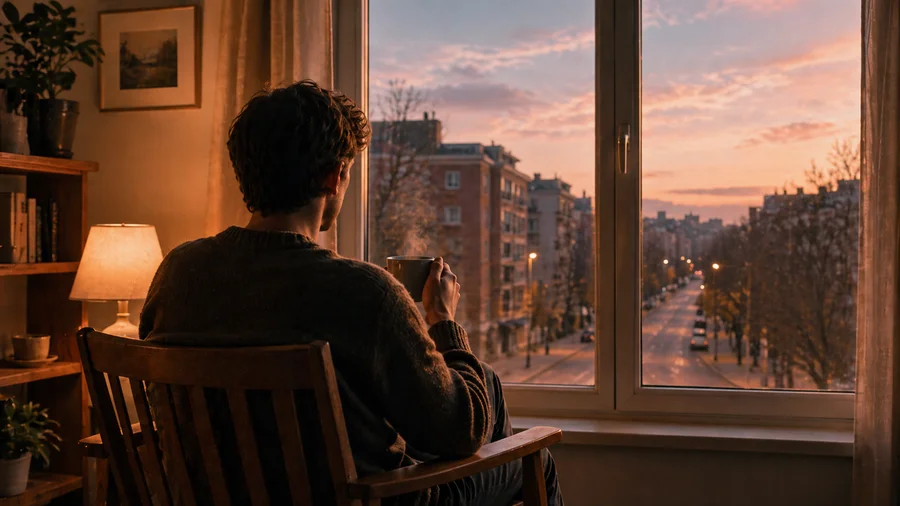
A quiet evening by the window. Image: ChatGPT
Loneliness: When Silence Becomes a Constant Companion
This text would actually fit on my "About Me" page. What follows is more personal than anything else I've written about myself. But it grew too long for a self-introduction, so it gets its own place here.
When Nobody Asks How You're Doing
There's that moment in the evening when I notice that nobody wanted anything from me all day. No message, no call, no question, no "do you have a minute?" At first that sounds relaxing, almost like a privilege in a world that's otherwise so loud with demands for attention. But it's not a privilege when it happens every day. Then it becomes something else. It becomes the slow disappearing from other people's lives.
I'm writing this because the topic of loneliness is almost always handled the wrong way. It gets treated like a temporary condition you can solve with a few good tips. Get out more. Join a club. Find hobbies. These suggestions aren't wrong, but they assume preconditions that not everyone has. They work for people whose lives haven't yet fallen out of the structures where contact happens naturally. To others, they sound like mockery.
It Wasn't Always Like This
What matters to me is saying this: I wasn't always lonely. Far from it. During my university years I lived in a student dorm, and there was always something going on. You'd run into people in the hallway, in the kitchen, at someone's party on the weekend. In the years after that there was still a time when social life just happened on its own. There was the regular group of friends you'd go to the club or the pub with every week. They weren't deep friendships in the grand sense, but they were enough. You felt included, thought of, part of something.
What I didn't understand back then: that kind of social life was carried by external structures, not by anything I was actively doing. The dorm, the city, the phase of life when everyone around you was in a similar situation. These structures carry many people through their early adult years without them even noticing. It's only when the structures fall away that you see what's actually grown underneath.
In my case, not much. The people from the club years got married, had kids, moved away, found new circles through their families. That's not a complaint, it's just what happens. But most others apparently had a second network running in parallel, something they could fall into when the first one dissolved. I didn't have that. I probably failed to invest early enough in friendships that would still hold up when life phases changed. Today I have no contact left with anyone from that whole period.
What Came on Top
I'm not telling this to ask for sympathy, but because it's part of the story. My mother died when I was sixteen. My father a few years later, when I was in my early twenties. My brother eventually cut contact, no explanation, just like that. A door that closed, and nobody tells you why.
Other people build their adult lives on a base layer they rarely name, because it's just there. Parents who call. Siblings you spend Christmas with. A family that thinks of you, even when you're not around. I didn't have that base layer anymore, and while my friends from earlier years grew into their own families, there was no equivalent movement in my life. There was just the slow getting quieter.
Then came Covid. Suddenly the office was gone, the lunch breaks with colleagues, the small encounters in the hallway. What had been a last bit of daily human contact got replaced by a headset. Voices without faces. I didn't know back then that working from home wouldn't end for me. Three years later I was diagnosed with CMT, that increasingly limits how I walk. Since then, working from home isn't a choice anymore. It's a necessity.
The Invisible Requirement of Friendship
Hardly anyone says this out loud, but friendship has an invisible requirement: spontaneity. The ability to say "yeah, I'll come over" or "let's do something Saturday." That kind of ease, the one that quietly structures most people's social lives, isn't something I have anymore. If I want to go somewhere, it's a project. Routes need to be planned, energy budgeted, breaks factored in. What's an impulse for others is logistics for me.
And logistics doesn't mix with friendship. Friendships live on small movements, on dropping by, on uncomplicated meetups. Whoever becomes harder to reach drops out of other people's day-to-day. Whoever drops out of the day-to-day stops being thought of. Whoever stops being thought of eventually disappears from people's plans. That's how the mechanism works, and it feels unstoppable.
But there's a second layer, and it's harder to put into words. It's not just a question of how many people are in my life. It's a question of who I matter to. Those are different things. You can have contacts you chat politely with and still feel that nobody would really notice if you weren't here tomorrow. This kind of loneliness isn't quantitative, it's qualitative. You can't solve it with more encounters, because the problem isn't the count, it's the weight.
What a Relationship Actually Gives You
When I think about loneliness, it's not just about missing friends. It's also about what a relationship simply brings with it, and what's missing when you're on your own. And I don't mean grand romance, I mean the small everyday things you usually never talk about.
Take the question in the evening, how was your day. Sounds banal, and in relationship advice columns it usually shows up as the textbook example of a routine that's gone stale. But it's only when nobody asks anymore that you realize how much that question actually does. It means: there's someone who cares what happened to you today. There's someone besides you thinking about your day. When that question is missing, what's missing isn't just conversation. It's the quiet sign that your life matters to somebody.
Then there's physical closeness. And I'm not even talking about sex yet, that comes next. I mean touch itself. A hand on your shoulder, an arm around you, someone sitting next to you on the couch. People without a partner can go months without being touched. And that does something to you that's hard to describe. At some point your body itself starts to register that something it actually needs is missing. It's not real pain, more like a quiet deficit you only notice when you do get touched again, at the hairdresser maybe, or at the doctor's. That's when it hits you how rare it's become.
Let's talk about sex. I think you should be able to bring that up in a piece like this without it getting awkward. Sex isn't just a nice extra in a relationship. It's its own kind of closeness, and you can't replace it with anything else. People without a partner usually don't have sex either. And that belongs in the picture if you're being honest about loneliness. It's not the most important thing, but it isn't nothing. And the longer it's missing, the clearer it becomes that this too is a form of closeness you're going without.
Conclusion
There's no neat conclusion to land on here. I can't end this text with some call that everything will be fine if you just work on yourself. That wouldn't be honest. There are situations in life where the tools that help others simply aren't available. I can't "just get out more" when getting out is a physical effort. I can't "meet new people" when the places where that happens have become unreachable for me. And I can't bring back a family that isn't there anymore.
But what I can say is that naming this does something in itself. As long as nobody talks about loneliness because it feels like failure or self-pity, it stays a private problem in a thousand separate apartments. The moment it gets spoken out loud, it stops being a personal flaw. It becomes what it actually is: the result of structures that work for some people and don't for others.
Maybe someone will read this who feels exactly the same. Who lives the same silence in the morning and the same stillness at night. Who's also realized that the advice handed out again and again misses their reality. If so, I want that person to know: you're not alone in being alone. That's not the kind of comfort that fixes anything. But it's more than nothing.