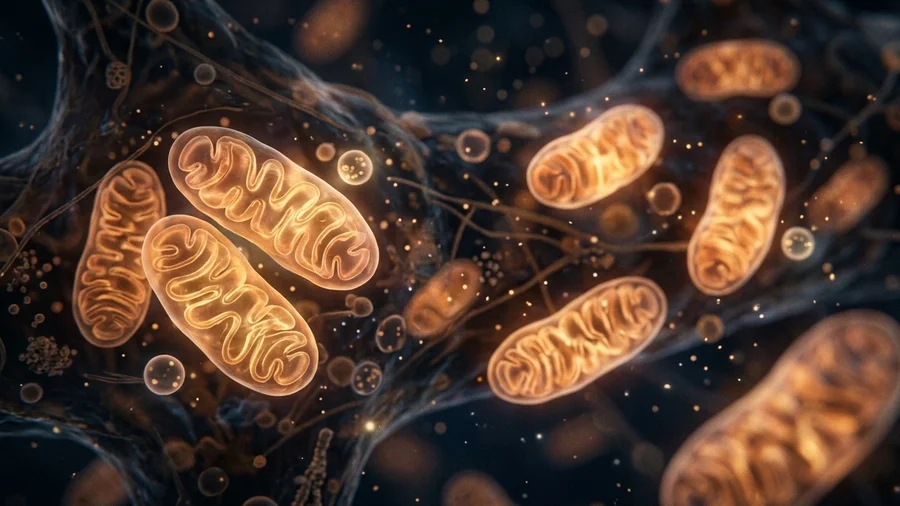
Mitochondria within a nerve cell
New Research on CMT2A: How AI Could Help Find a Treatment
Sometimes you read a research update and think: okay, this doesn't really concern me directly. This time was different. The study I'm writing about here is about exactly the form of CMT I have myself. And it gives me cautious hope.
What CMT2A Actually Is
CMT2A is the most common variant of CMT type 2, affecting about three percent of all CMT patients. It's almost always caused by a mutation in the MFN2 gene, which provides the blueprint for a protein called mitofusin-2.
This protein keeps the energy supply running along the nerves. When the protein is faulty, energy doesn't reach the places where it's needed.
One important detail: more than 100 different mutations in the MFN2 gene can cause CMT2A. That's what makes developing a treatment so complicated. What works for one mutation might not work for another.
What the Research Has Found So Far
At the University of California, San Diego, a team led by Dr. Uri Manor has been working on exactly this problem. In May 2026, they published the final report of a first project that laid the groundwork for everything that comes next.
Using AI-powered imaging, the team made visible what's actually happening inside the cells of CMT2A patients. Specifically: the movement of mitochondria (the cell's power plants) and lysosomes (responsible for clearing out cellular waste) is genuinely disrupted in nerve cells.
They also developed a rat model carrying a specific MFN2 mutation that mirrors the disease well. That matters, because it means what gets tested in the lab can realistically translate to patients.
With that, the team has built the tools that are needed to test any future treatment in a meaningful way.
The Therapeutic Approach: Antisense Oligonucleotides
The next step is the development of so-called antisense oligonucleotides, or ASOs for short.
It sounds technical, but it's easy to picture: an ASO works like a piece of tape stuck over a faulty section of the genetic instructions. The cell can no longer read that section and stops producing the faulty protein. The healthy copy of the gene stays untouched and keeps working normally.
ASOs aren't science fiction. They're already approved and in clinical use for other neurological conditions like spinal muscular atrophy. For CMT2A, this would be a new application, but the principle is well established.
What Comes Next
In May 2026, the CMT Research Foundation announced a new three-year follow-up project, also led by Dr. Manor. The goal is more concrete than in the previous one:
Building a complete pipeline to identify and pre-clinically validate the best therapeutic candidate for CMT2A.
The team plans to reprogram skin cells from CMT2A patients into nerve cells. Using those, the researchers want to identify the "fingerprint" of the disease: the cellular patterns that show up regardless of which specific MFN2 mutation a patient carries.
This is the part that really caught my attention. If the approach works, the resulting treatment could potentially be effective for many different MFN2 mutations, not just one.
After that, various genetic candidate drugs will be compared directly. The most promising one moves on to pre-clinical models. By the end of the three years, the team expects to have a validated lead therapy ready for clinical trials.
What This Means for Me
I was diagnosed in 2023. CMT2A is a progressive condition, meaning it gets worse over time, not better. There's currently no treatment that halts the progression. You can treat symptoms, use aids, do targeted physiotherapy, but the underlying course of the disease can't be stopped.
Research updates like this don't change that in the short term. Three years for the next project phase, then clinical trials, then regulatory approval. We're talking about timeframes measured in years, not months.
But they do change something about the outlook.
When it comes to CMT2A treatments, the goal isn't to bring back nerves that have already died. That isn't possible today. The goal is to slow down or stop the progression.
And that's the part that matters to me. Even if a treatment only becomes available years from now, there's a real chance that whatever function is still left by then can be preserved.
That's a lot more than nothing. That's a lot.
I'm cautiously optimistic. Cautious, because promising lab results don't always turn into approved treatments. Optimistic, because CMT research has genuinely moved forward in recent years.
Conclusion
Research on CMT2A is making progress, even if the road to an approved treatment is still long. With AI-powered analysis, the new rat model, and the concrete prospect of an ASO-based therapy, a realistic path forward is visible for the first time.
For those affected, the takeaway is: it's worth following these developments. I'll keep reporting on the blog as things progress.
Frequently Asked Questions About CMT2A Research
What exactly is CMT2A?
Why is CMT2A research so complicated?
What are antisense oligonucleotides (ASOs)?
When will there be a treatment for CMT2A?
Can a future treatment undo damage that's already happened?
Sources
- CMTA USA: Tiny Movers, Big Clues: Using AI to Shed Light on CMT2A
- CMT Research Foundation: New Study at UC San Diego Aims to Identify Best Genetic Treatment for CMT2A
- CMT Research Foundation: CMT2A Guide: Symptoms, Causes and Treatments